
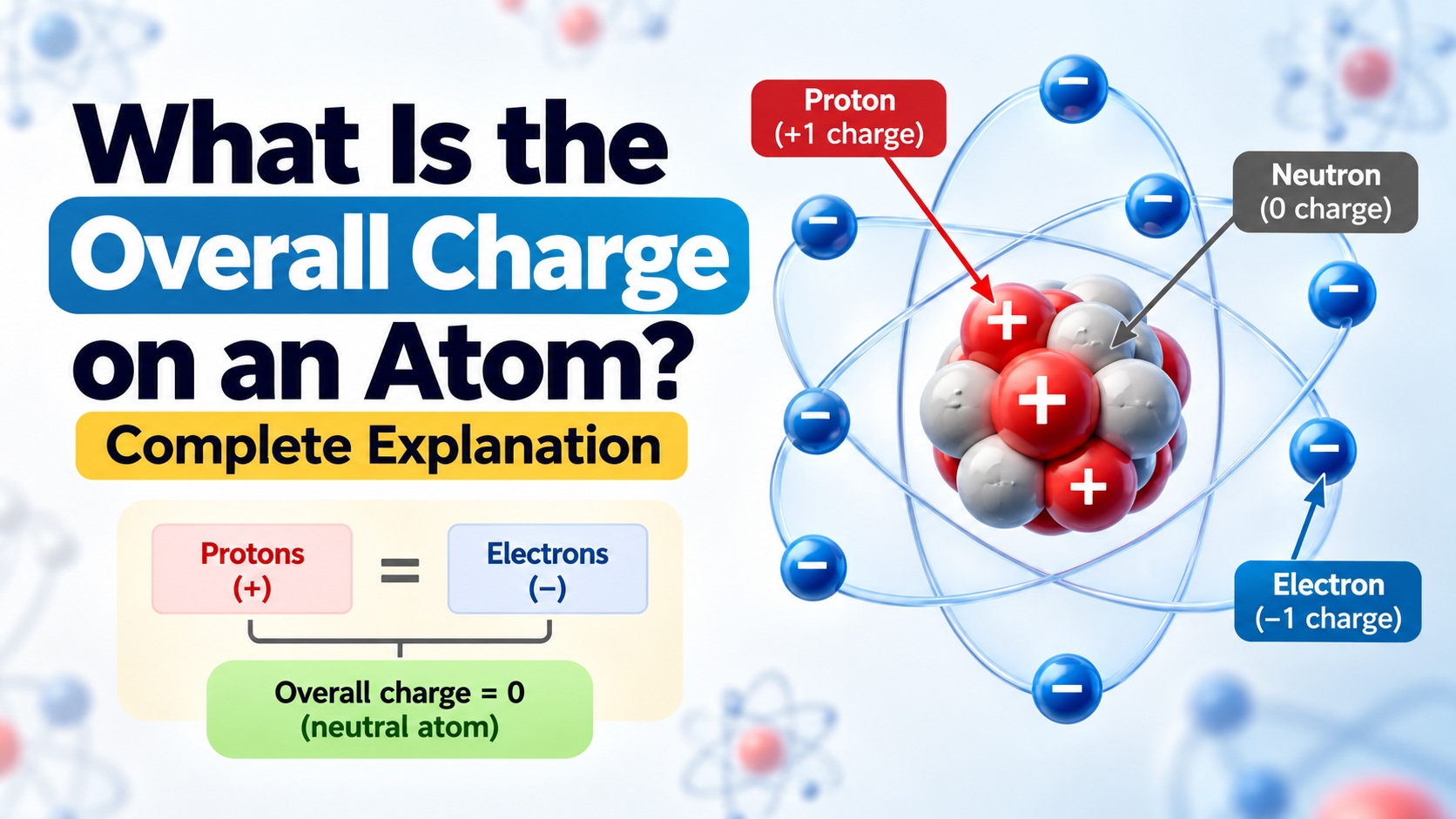
The overall charge on an atom is usually zero. This happens because a neutral atom has the same number of protons and electrons. Protons have a positive charge, while electrons have a negative charge. These charges are equal in size but opposite in sign, so they cancel each other out. As a result, the atom has no overall electric charge. If the number of protons and electrons is not equal, the particle becomes charged and is called an ion.
This idea is simple, but it is very useful in chemistry. Once you understand how protons and electrons affect charge, many questions become much easier. You can work out whether an atom is neutral, positive, or negative by comparing these two particles. This guide explains the overall charge on an atom, how to calculate it, how ions form, and what common mistakes students should avoid.
What Is the Overall Charge on an Atom?
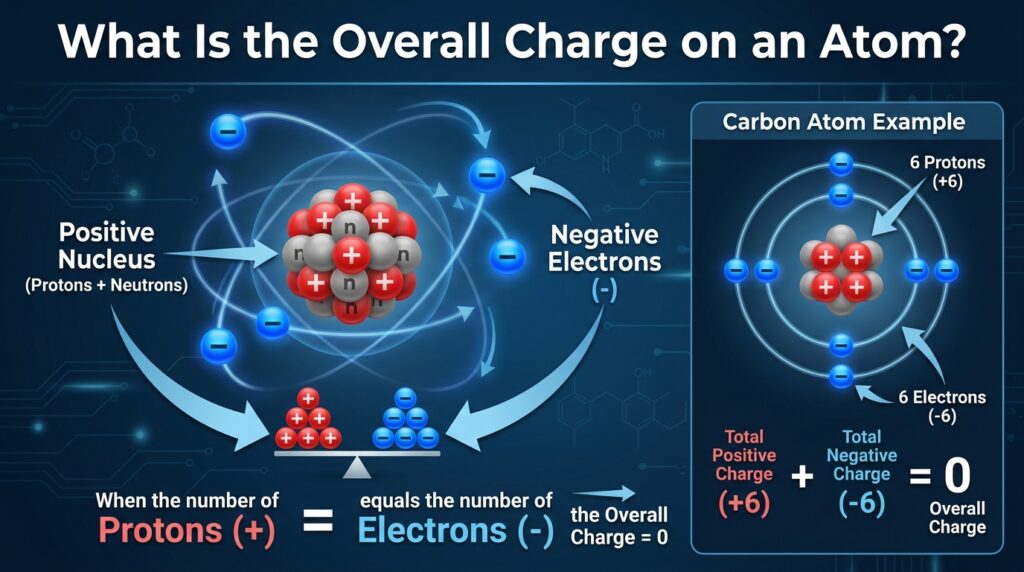
For a neutral atom, the overall charge is 0. The atom contains positively charged protons and negatively charged electrons. When the number of protons matches the number of electrons, the charges balance. For example, a carbon atom has six protons and six electrons when it is neutral. The six positive charges are balanced by the six negative charges, so the total charge is zero.
The word “overall” means the final charge after all positive and negative charges are added together. It does not mean every part of the atom has no charge. The nucleus is positive because it contains protons, while the electrons around the nucleus are negative. Even though these parts have different charges, the atom as a whole can still be neutral when both sides are equal.
How Protons, Electrons, and Neutrons Affect Charge
Atoms are mainly explained using three particles: protons, electrons, and neutrons. A proton has a charge of +1, while an electron has a charge of −1. A neutron has no electric charge, so its charge is 0. Protons and neutrons are found in the nucleus of the atom. Electrons are found in the space around the nucleus.
Only protons and electrons matter when you are finding the overall charge. Neutrons do not make an atom more positive or more negative. For most school chemistry questions, you do not need to use the charge in coulombs. You can simply count each proton as +1 and each electron as −1. This makes it much easier to work out the final charge.
How to Calculate the Charge of an Atom
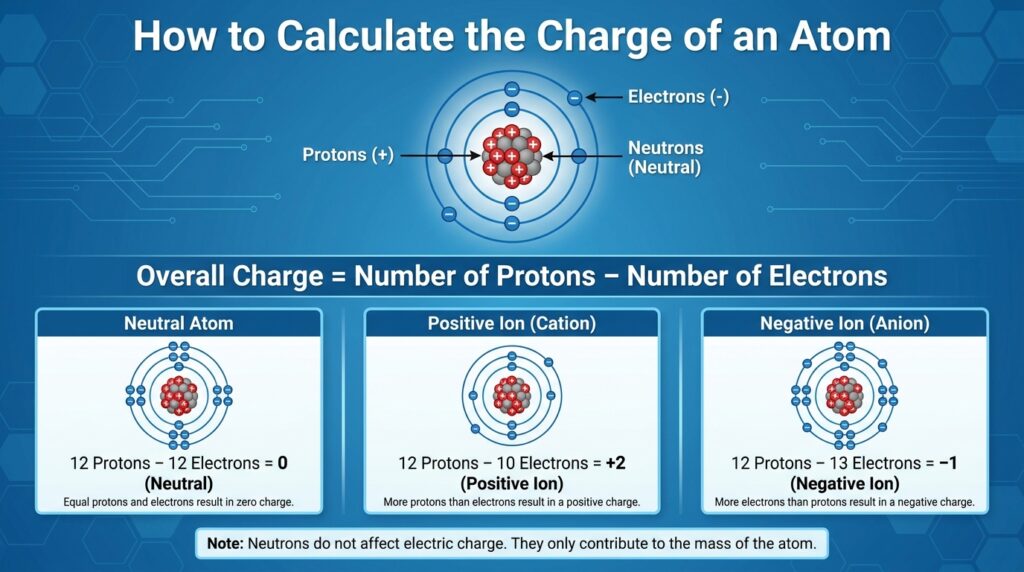
You can calculate the charge of an atom with a simple rule. Subtract the number of electrons from the number of protons. If the answer is 0, the atom is neutral. If the answer is positive, the particle has a positive charge. If the answer is negative, the particle has a negative charge. Neutrons are not included because they do not have an electric charge.
For example, imagine an atom with 12 protons and 12 electrons. The calculation is 12 − 12 = 0, so the atom is neutral. If the same atom had only 10 electrons, the calculation would be 12 − 10 = +2. It would have a positive charge. If it had 13 electrons, the result would be 12 − 13 = −1, so the particle would have a negative charge.
How an Atom Becomes an Ion
An atom becomes an ion when its number of electrons changes. If an atom loses one or more electrons, it has more protons than electrons. This gives the particle a positive charge. A positively charged ion is called a cation. If an atom gains electrons, it has more electrons than protons. This gives it a negative charge, and the particle is called an anion.
For example, a neutral sodium atom has 11 protons and 11 electrons. If it loses one electron, it still has 11 protons but now has only 10 electrons. Its overall charge becomes +1. A neutral oxygen atom has eight protons and eight electrons. If it gains two electrons, it has eight protons and ten electrons. Its overall charge becomes −2.
Why the Number of Protons Matters
The number of protons in an atom is called its atomic number. This number tells you which element the atom is. For example, hydrogen has one proton, carbon has six protons, and oxygen has eight protons. If the number of protons changes, the element itself also changes. This is why an atom normally becomes an ion by gaining or losing electrons rather than changing its protons.
It is also important not to confuse atomic number with overall charge. Atomic number tells you how many protons are present. Overall charge compares the number of protons with the number of electrons. A particle can have 11 protons and still have either a neutral or positive charge. If it has 11 electrons, the charge is 0. If it has 10 electrons, the charge is +1.

Neutral Atoms, Ions, and Isotopes Are Different
A neutral atom has the same number of protons and electrons. An ion has a charge because the number of protons and electrons is different. An isotope is something else. Isotopes of the same element have the same number of protons but different numbers of neutrons. The neutron count can change the mass of the atom, but it does not directly change its electric charge.
For example, two carbon isotopes may contain different numbers of neutrons. They are still carbon because both have six protons. If each isotope also has six electrons, both are neutral. If one loses an electron, it becomes positively charged. This shows why it is useful to keep three ideas separate. Protons identify the element, neutrons help identify the isotope, and protons plus electrons determine the charge.
Common Mistakes When Finding Atomic Charge
A common mistake is adding protons and electrons together without thinking about their signs. Ten protons and ten electrons do not give a total charge of 20. Protons are positive, while electrons are negative. Their charges cancel, so +10 and −10 give an overall charge of 0. Another mistake is including neutrons in the charge calculation. Neutrons affect mass, but they do not add positive or negative charge.
Students can also get confused by positive and negative ion signs. A −2 ion has two more electrons than protons. A +2 ion has two fewer electrons than protons. The easiest way to check is to compare the two numbers. If there are more protons, the charge is positive. If there are more electrons, the charge is negative. If both numbers are equal, the atom is neutral.
Why Atomic Charge Matters in Chemistry
Electric charge helps explain how atoms and ions behave. Positive and negative charges attract each other, while charges with the same sign repel each other. These forces help explain why ions can join together and form compounds. Charge is also important when writing chemical formulas, understanding reactions, and keeping track of electron changes.
Atomic charge also makes many periodic table questions easier. The atomic number tells you the number of protons. In a neutral atom, it also tells you the number of electrons. If an atom gains or loses electrons, you can use the ion charge to work out the new electron total. Instead of memorizing everything, you can often solve the problem by counting protons and electrons carefully.
Frequently Asked Questions
What is the overall charge on an atom in one number?
For a neutral atom, the overall charge is 0. The positive charge from the protons is balanced by the negative charge from the electrons.
Can an atom have a positive charge?
Yes. An atom can become positively charged if it loses one or more electrons. It then has more protons than electrons and becomes a positive ion, or cation.
Can an atom have a negative charge?
Yes. An atom becomes negatively charged when it gains extra electrons. It then has more electrons than protons and becomes a negative ion, or anion.
Do neutrons affect the charge of an atom?
No. Neutrons have no electric charge, so they do not make the atom more positive or negative. They mainly affect the atom’s mass and isotope.
Does changing the charge change the element?
Changing the number of electrons does not change the element. The element is decided by its number of protons. As long as the proton count stays the same, the element stays the same.
What is the charge of one proton or electron?
A proton has a charge of +1, while an electron has a charge of −1 when using simple atomic charge units. Their charges are equal in size but have opposite signs.
Final Thoughts
So, what is the overall charge on an atom? For a neutral atom, the answer is 0. The positive charges from the protons are balanced by the negative charges from the electrons. Neutrons do not affect the charge because they are electrically neutral. Once you remember this basic rule, atomic charge questions become much easier to understand.
If the number of protons and electrons is different, the particle becomes an ion. More protons give a positive charge, while more electrons give a negative charge. Equal numbers give a neutral atom. Keeping protons, electrons, neutrons, atomic number, and ions separate will help you solve many basic chemistry questions with less confusion.
Disclaimer
This article is for general educational information. It was written with AI assistance and may not cover every classroom method or special case. Scientific information and teaching materials can change, so check important details with a trusted textbook, teacher, scientific source, or other reliable reference before using the information for formal study.