
If you are asking “how much National Insurance do I pay?”, the answer depends on how much you earn and whether you are employed or self-employed. Employees usually pay Class 1 National Insurance through their wages, while self-employed people may pay Class 4 based on their yearly profits. The rules can also change when you reach State Pension age. This guide explains the UK National Insurance rules for the 2026/27 tax year, which runs from 6 April 2026 to 5 April 2027.
You will learn about the current employee rates, monthly thresholds, self-employed National Insurance, and common salary examples. This guide also explains how the rules work in Scotland, what happens when you reach retirement age, and when voluntary payments may be useful. Your exact National Insurance can sometimes look slightly different from a simple yearly calculation because employee contributions are usually worked out during each pay period, such as weekly or monthly.
How Much National Insurance Do I Pay as an Employee in 2026/27?
Most employees start paying Class 1 National Insurance when their wages go above the Primary Threshold. During the 2026/27 tax year, the standard employee rate is 8% on earnings between £242 and £967 a week. For monthly workers, this is equal to earnings between £1,048 and £4,189 a month. The annual figures often used for simple estimates are £12,570 and £50,270. If your earnings go above the upper limit, the standard employee rate falls to 2% on the amount above that level.
This does not mean you pay 8% on your whole salary. Only the part of your earnings that sits inside the 8% band is charged at that rate. There is also a Lower Earnings Limit of £129 a week, or £559 a month. If you earn between this amount and the Primary Threshold, you normally do not pay employee National Insurance. However, you may still be treated as having paid contributions, which can help protect your National Insurance record. These figures apply to the standard position for many workers, but other National Insurance category letters can use different rates.
How Much National Insurance Do I Pay Per Month?
You can get a simple monthly estimate by starting with your gross monthly wage before normal payroll deductions. If you earn £1,048 a month or less, your standard employee National Insurance is normally £0. If you earn between £1,048 and £4,189, subtract £1,048 from your monthly wage and charge 8% on the remaining amount. If your pay goes above £4,189, the part up to that level is charged at 8%, while the amount above it is normally charged at 2%.
For example, imagine you earn £30,000 a year and receive twelve equal monthly payments. Your gross monthly wage would be £2,500. After the monthly threshold is taken into account, your National Insurance would be about £116.16 in a normal month. This comes to around £1,393.92 across twelve similar months. If you earn £35,000 a year, your monthly gross wage is about £2,916.67. Your National Insurance would be about £149.49 in a normal month, or around £1,793.88 across twelve similar months.
A yearly calculator and your real payslip may not always show exactly the same result. This is because employee National Insurance is normally worked out using your actual pay period. A monthly worker uses monthly thresholds, while a weekly worker uses weekly thresholds. Bonuses and other changes in pay can also affect the amount for a certain month. Payroll rounding may create small differences as well.
The main thing to remember is that you should use the correct pay period when checking your National Insurance. Do not simply take 8% of your full wage, because that will usually give the wrong result. Part of your income may sit below the Primary Threshold, and higher earnings can enter the 2% band. Using the proper thresholds gives you a much more accurate idea of how much National Insurance you pay each month.

How Much National Insurance Do I Pay if Self-Employed?
Self-employed National Insurance is based on your profit rather than your total business income. Profit is generally the money left after allowable business expenses have been taken away from your self-employed income. For the 2026/27 tax year, Class 4 National Insurance starts when annual profits go above £12,570. The rate is 6% on profits between £12,570 and £50,270. Any profit above £50,270 is charged at 2%.
For example, if your self-employed profit is £30,000, then £17,430 sits inside the 6% Class 4 band. This gives a simple Class 4 National Insurance estimate of about £1,045.80. If your profit is £35,000, the estimate rises to about £1,345.80. Self-employed people should remember that these figures are based on profit, not on total sales or business turnover.
Class 2 National Insurance now works differently from the older system that some people may remember. If your self-employed profits are at least £7,105, Class 2 contributions are generally treated as paid. You normally do not need to make a separate Class 2 payment to receive this treatment. If your profits are below £7,105, you may be able to pay voluntary Class 2 contributions, depending on your situation.
The voluntary Class 2 rate for 2026/27 is £3.65 a week. Class 4 is normally dealt with through Self Assessment. If you are both employed and self-employed, you may pay Class 1 through your wages and also owe Class 4 on your business profits. HMRC can work out your final National Insurance position after your Self Assessment information has been processed.
Do Scotland, Age, and Retirement Change What You Pay?
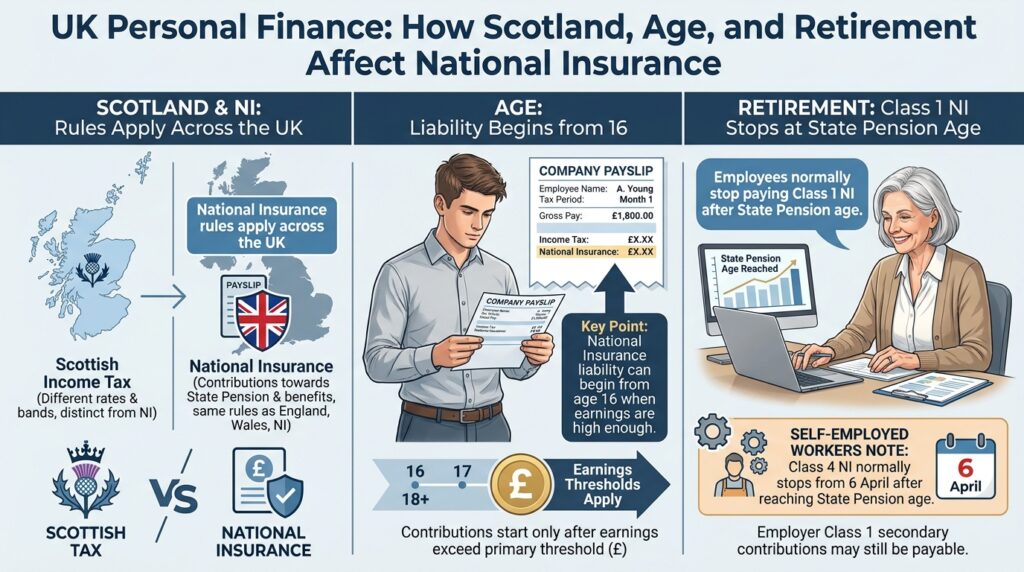
National Insurance rates and thresholds apply across the UK, including Scotland. Scotland has its own Income Tax rates and bands for Scottish taxpayers, but National Insurance remains a UK-wide system. This means two people earning the same wage may pay different amounts of Income Tax depending on where they live, but the standard National Insurance rules are not changed by Scottish Income Tax bands.
This distinction can be confusing because Income Tax and National Insurance are both taken from wages. They are separate charges and use different rules. When you work out National Insurance in Scotland, you should use the normal UK National Insurance thresholds rather than Scottish Income Tax bands. Your National Insurance amount will still depend on your earnings, employment type, and category letter.
You can generally become liable for National Insurance from age 16 if your earnings or profits are high enough. Simply turning 16 does not automatically mean you must make a payment. If your income stays below the relevant threshold, you may not owe any National Insurance. Some lower earners can still receive National Insurance credits or be treated as having contributions on their record.
Employees normally stop paying Class 1 National Insurance after reaching State Pension age, even if they continue working. Self-employed people stop paying Class 4 from 6 April after they reach State Pension age. Your age, earnings, and type of work all matter, so the correct amount can vary from one person to another.
How to Check Your National Insurance and Avoid Common Mistakes
The easiest place to start is your payslip. Check your gross pay, pay period, National Insurance category letter, and the amount taken from your wages. Make sure you are using the current 2026/27 National Insurance rates when checking the figures. Older calculators for 2022, 2023, or 2024 may give the wrong result because National Insurance rates have changed over recent tax years.
HMRC also provides online services that can help employees estimate Income Tax and National Insurance for the current tax year. These tools can be useful when you want a quick check against your payslip. However, your real payroll result may still be slightly different because your employer uses your actual pay period, category letter, bonuses, and other payroll details.
Another common mistake is confusing employee National Insurance with employer National Insurance. Your employer may also have to pay National Insurance because you work for them, but this is a separate cost. The employer contribution is not the same as the National Insurance amount taken from your own wages. You should look only at your own employee deduction when checking how much you personally pay.
You should also take extra care if you have more than one job, receive irregular wages, get large bonuses, or have both employment and self-employment income. These situations can make the calculation less simple. If the amount on your payslip still looks wrong, you can speak to your payroll department or HMRC. You can also check your National Insurance record online to see your contributions, credits, and any gaps.

Frequently Asked Questions
Do I pay National Insurance on all of my salary?
No. Most employees only pay National Insurance on the part of their earnings that falls inside the relevant bands. During 2026/27, the standard 8% rate starts above the Primary Threshold. Earnings above the Upper Earnings Limit are normally charged at the lower 2% employee rate.
What happens if I have more than one job?
National Insurance may be worked out separately for each job, depending on your employment setup. If you use an HMRC employee calculator, you may need to check each job separately. Some higher earners with more than one employer may also qualify to defer part of their Class 1 National Insurance.
Can I get a National Insurance refund if I paid too much?
Yes, you may be able to claim a refund if you have overpaid National Insurance. The correct process depends on the type of contribution and why the overpayment happened. Check your payslips and National Insurance record first, then follow the relevant HMRC refund process.
Can I pay National Insurance voluntarily?
Some people can make voluntary National Insurance contributions to fill gaps in their record. For 2026/27, the Class 3 voluntary rate is £18.40 a week. Eligible people may also be able to pay voluntary Class 2 at £3.65 a week. It is wise to check your National Insurance record and State Pension forecast first because paying for a gap does not always increase your State Pension.
Does my employer’s National Insurance come out of my wages?
No. Employer National Insurance is a separate payment made by your employer. Your employee National Insurance is the amount deducted from your own wages. Employer contributions use different thresholds and rates, so they should not be added to your personal deduction.
Why does an online calculator show a different National Insurance figure?
The calculator may be using a different tax year or different assumptions about your income. It may also calculate National Insurance using a yearly estimate instead of your actual weekly or monthly pay period. Bonuses, irregular wages, payroll rounding, and your National Insurance category letter can also change the result.
Final Thoughts
If you are wondering how much National Insurance you pay in 2026, the main figures are fairly simple once you understand the bands. For most employees, the important monthly threshold is £1,048, and the standard rate above this point is 8%. Earnings above £4,189 a month normally move into the 2% employee band. Self-employed people use profit limits instead, with Class 4 charged at 6% and 2% across the relevant bands.
For the most accurate answer, start with your latest payslip or your self-employed profit figure. Then compare it with the current 2026/27 HMRC thresholds. If the numbers still do not look right, check your National Insurance record or ask HMRC or your payroll team for help. This is more reliable than using an old calculator or applying one National Insurance rate to your whole income.
Disclaimer
This article gives general information and was written with AI assistance. National Insurance rules, rates, and individual circumstances can change, and this guide may not cover every situation. Check important or current details through HMRC or another trusted official source before making tax or financial decisions.