
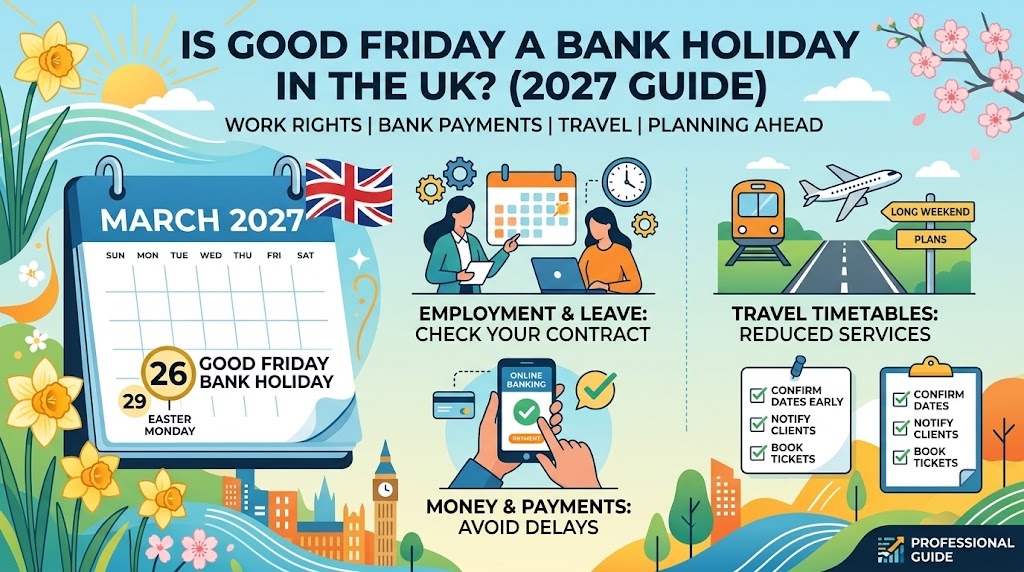
Many people ask, “Is Good Friday a bank holiday in the UK?” before they book travel, plan a shift, or pay a bill. The short answer is yes. Good Friday is a bank holiday in England, Wales, Scotland, and Northern Ireland. Banks close, many offices shut, and the country settles into a long Easter weekend. A clear answer helps you avoid surprises at the bank, the shop, or work.
This guide explains the rules in plain words. You will see the Good Friday date for 2026, plus dates for 2019 and 2023. You will learn how Good Friday differs from Easter Monday and what usually closes. We also cover work rights, bank payments, travel, common mistakes, and how to plan ahead. The 2026 date has now passed, so we also look at 2027.
Is Good Friday a Bank Holiday in the UK?
Yes, it is. The UK government lists Good Friday as a bank holiday in every UK nation each year. A bank holiday is a day when banks and many businesses close. Good Friday falls on the Friday before Easter Sunday, so the date changes every year. It always lands in March or April.
Some people think bank holidays are the same as school holidays. They are not. Schools set their own Easter break, and it often starts before or after Good Friday. Think of a bank holiday like a shared “pause button” for the working week. Schools, councils, and companies may press it at different times, but the day itself stays the same.
Good Friday Dates for 2026, 2019, and 2023
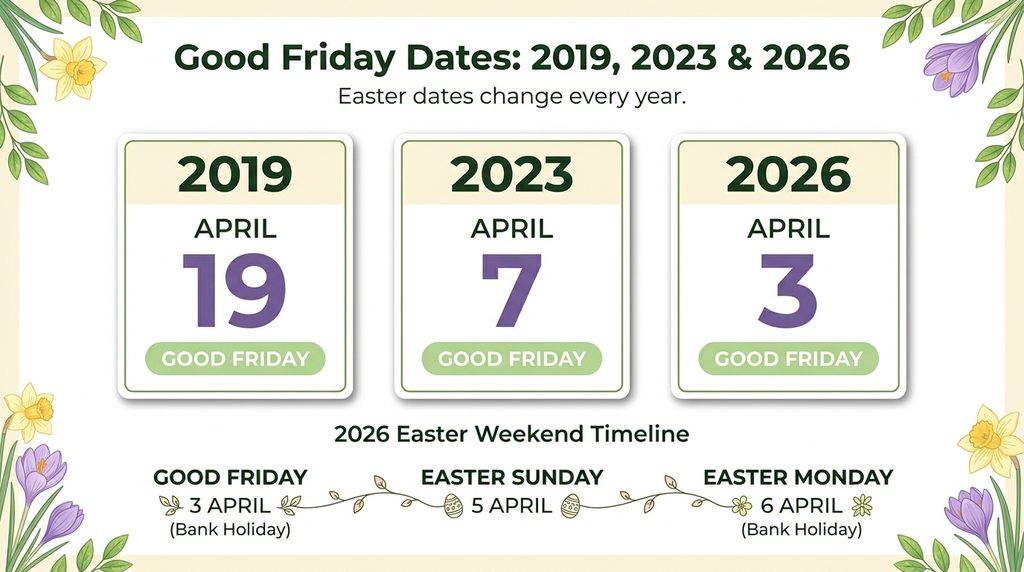
In 2026, Good Friday was on 3 April. Easter Sunday followed on 5 April, and Easter Monday fell on 6 April. If you read this in October 2026, that long weekend is already over. The next one comes in spring 2027, so you have plenty of time to plan.
Older dates can also matter. In 2019, Good Friday fell on 19 April. In 2023, it fell on 7 April. People often search for past dates to check old payslips, bills, or travel records. Because Easter moves each year, the same weekend never lands on the same date twice in a row.
Why the Good Friday Date Changes Every Year
Good Friday has no fixed date because Easter moves. Easter Sunday follows the spring equinox and the moon. Church rules place it on the first Sunday after a certain full moon in spring. Good Friday is the Friday two days before. This is why it can land anywhere from 20 March to 23 April.
You cannot reuse last year’s date for the next year. Think of it like a train that follows a moving timetable. A diary printed for 2027 will show 26 March, but a 2026 diary showed 3 April. Many calendar apps add the date for you. Still, check it against the official list before you make firm plans.
How to Check the Official Bank Holiday Dates
The UK government keeps an official list of bank holidays on its website. The list shows each nation on its own. You can look at England and Wales, Scotland, and Northern Ireland one by one. This matters because a few holidays differ between nations. The page usually covers the current year and the years ahead.
Employers and banks also share their own holiday notices. A bank may post a note about branch hours and payment times. Your workplace may share a yearly calendar with your days off. If the two sources do not match, ask your manager or your bank. The official list tells you the holiday, but your contract tells you what it means for you.
Good Friday and Easter Monday Are Not the Same
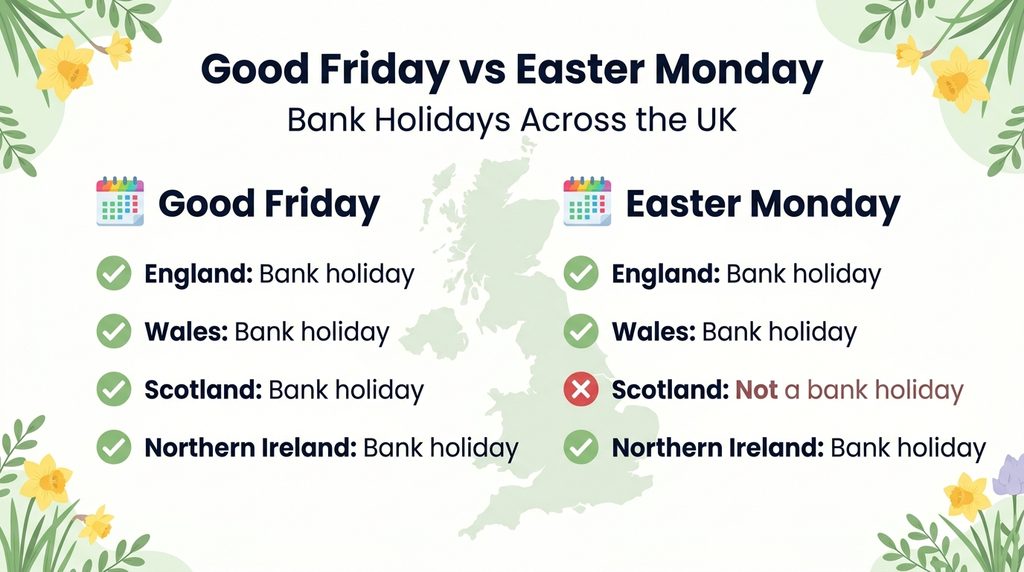
Good Friday and Easter Monday are both bank holidays in most of the UK. But they do not work the same way everywhere. Good Friday is a bank holiday in all four UK nations. Easter Monday is a bank holiday in England, Wales, and Northern Ireland. It is not a bank holiday in Scotland.
This difference can catch people out. Imagine you live in England and work with a team in Scotland. Your office may be closed on Easter Monday, but your Scottish colleagues may be working. Always check which holiday applies to the person or business you need. A quick look at the official government list saves a lot of confusion.
What Usually Closes on Good Friday
Banks and building societies are normally closed on Good Friday. Many government offices, courts, and council services also close. Most big companies give staff the day off. Stock markets in the UK are normally shut as well.
But the law does not close every shop. Many shops, cafes, and restaurants open on Good Friday, often with shorter hours. Supermarkets may run different times, so check before you go. Pubs and cinemas often stay open too. Local rules and company choices differ, so a short call or a look at a website helps.
Work, Pay, and Time Off
Many workers get Good Friday off, but the law does not always promise it. Your right to the day depends on your contract. Some contracts list bank holidays as paid days off. Others count them as part of your yearly leave. In many cases, you do not get extra pay for working on a bank holiday unless your employer agrees to it.
Shift workers should check their contract early. Think of a nurse, a driver, or a shop worker who is on the rota. Their employer may ask them to work, and the contract decides what happens next. If you are not sure, read your written terms or ask your manager. Your employer or an advice service can also explain your rights.
Money and Payments on Good Friday
Good Friday can change how fast your money moves. Bank branches are usually closed, so you cannot visit them for help. Some payment systems do not run on bank holidays. A payment sent by one of those systems may reach the other account on the next working day. Faster Payments often work on bank holidays, but your bank sets its own limits and rules.
Planning ahead helps a lot. Imagine your rent is due on the Friday before Easter. If you pay on Thursday, you avoid delays. Direct debits may also move to the next working day. Cheques can take longer to clear around Easter. Check your bank’s own notice for exact times.
Travel and Daily Life Over the Long Weekend
Good Friday is a busy time for travel. Many people take a long weekend, so roads, trains, and airports can fill up. Some train and bus services run on a reduced timetable, similar to a Sunday. Others run as normal. Because rules differ by operator and region, check your travel provider before you leave.
Daily services can change as well. Council bin collections may move by a day. Some doctors’ surgeries and pharmacies close or shorten their hours. Post offices and delivery services often change their times too. For urgent health needs, use the NHS guidance for your area. For parcels or letters, check the carrier’s holiday notice.
What Good Friday Means for Different People
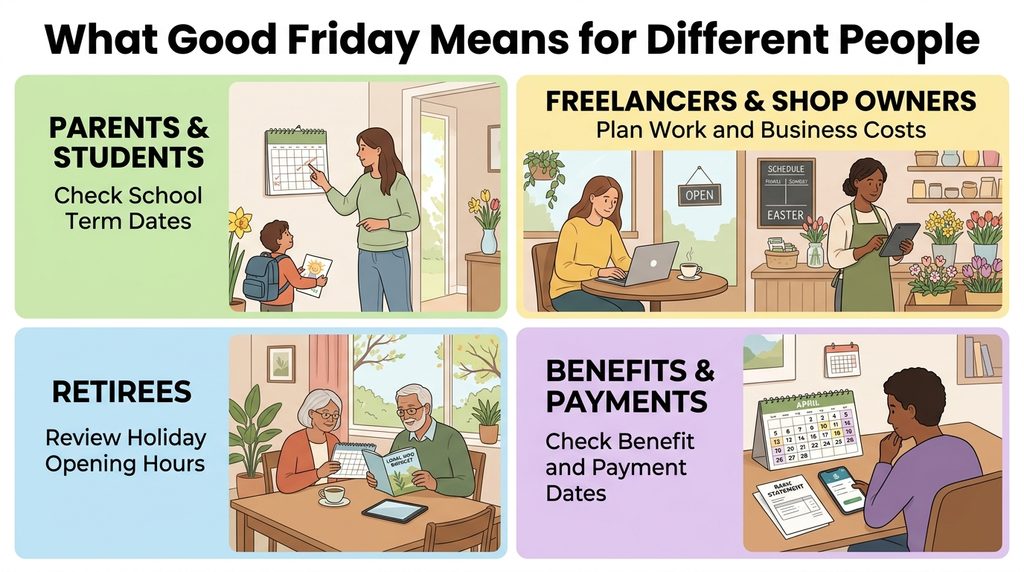
Parents and students should check the school calendar. Schools choose their own Easter break, so term dates differ by area. A child may be off before Good Friday, or the break may start after it. Parents who work may need to book childcare early. Colleges and universities set their own dates too.
Freelancers and shop owners face a different set of choices. A freelancer may lose a paid day if clients are closed. A shop owner may earn more from a busy long weekend. Each person should look at past years and plan stock, staff, and bills. Retirees and people who get benefits should also check payment dates, since a payment may move to a nearby working day.
Common Mistakes People Make
One common mistake is mixing up Good Friday with Easter Monday. As you saw earlier, Scotland handles Easter Monday differently. Another mistake is assuming every shop is closed. Many stay open, but hours vary. A third mistake is expecting a payment to arrive on the holiday itself. Some payments wait for the next working day.
People also forget to check their own contract. A friend may get the day off, but you may not. Another trap is trusting old advice. Rules and dates can change, and an old blog post may show last year’s plan. The easy fix is to check the official government page and your provider’s own notice. Spend two minutes on that check, and you can avoid most problems.
How to Plan for Good Friday Next Year
Start with the date. Good Friday in 2027 falls on 26 March, and Easter Monday follows on 29 March. Mark both on your calendar early. Then list the things you need to do before the break. Examples include paying bills, posting parcels, and booking tickets. Doing these tasks a few days early keeps stress low.
Next, tell the people who depend on you. If you run a small business, post your opening hours on your door and website. If you work in a team, share the holiday dates with everyone. A short message avoids missed calls and late orders. Check official sources again closer to the date, because plans can change.
Frequently Asked Questions
Is Good Friday a bank holiday in the UK in 2026?
Yes. In 2026, Good Friday fell on 3 April and was a bank holiday across the UK. The long weekend ran through Easter Monday on 6 April in most places. The date has passed, so the next one to plan for is in 2027.
Was Good Friday a bank holiday in the UK in 2019?
Yes. Good Friday in 2019 fell on 19 April and was a bank holiday. Easter Monday followed on 22 April in England, Wales, and Northern Ireland. People often look up this date to check old records or payments.
Was Good Friday a bank holiday in the UK in 2023?
Yes. Good Friday in 2023 fell on 7 April and was a bank holiday. Easter Monday came on 10 April in England, Wales, and Northern Ireland. The same pattern repeats each year, but the dates move.
Do all UK shops close on Good Friday?
No. Many shops, supermarkets, and cafes open on Good Friday, often for shorter hours. Some small shops may close, and hours can differ by town. Check the store’s own website or call ahead if you need something.
Do I get paid extra for working on Good Friday?
Not always. Extra pay depends on your contract or your employer’s policy. The law does not give a general right to extra pay for bank holiday work. Read your written terms or ask your manager to be sure.
Are public transport services running on Good Friday?
Many services run, but timetables often change. Some use a reduced or Sunday-style plan. Others run as usual. Check your train, bus, or tram operator before you travel, because plans differ by region.
Final Thoughts
So, is Good Friday a bank holiday in the UK? Yes, it is, in all four nations. The date changes each year, and it always sits right before Easter Sunday. In 2026 it fell on 3 April, and the next one is 26 March 2027. Knowing the rules helps you plan work, money, and travel with less stress.
Your next step is simple. Check the official government list for the year you need. Then check your contract, your bank, and your travel provider. A few quick checks can save you from missed payments and closed doors. Enjoy the long weekend when it comes.
Disclaimer
This article gives general information only. It was written with AI assistance. Dates, rules, and services can change, and the article may not cover every situation. Please check important or current details with official or trusted sources before you rely on them.