
The New York Knicks and Cleveland Cavaliers met in an important playoff game on May 25, 2026. The Knicks defeated the Cavaliers 130–93 at Rocket Arena in Cleveland. It was Game 4 of the Eastern Conference Finals, and the win completed a 4–0 series sweep for New York. The knicks vs cleveland cavaliers match player stats show how New York controlled the game through strong shooting, rebounding, passing, and scoring depth.
This guide looks closely at the player stats and team numbers from Game 4. Karl-Anthony Towns led the Knicks with 19 points and 14 rebounds, while Donovan Mitchell scored a game-high 31 points for Cleveland. The final box score also shows why the difference between the two teams became so large as the game went on.
Latest 2026 Knicks vs Cavaliers Game Overview
New York took control early and did not allow Cleveland to settle into the game. The Cavaliers briefly led 17–16 during the first quarter, but the Knicks soon moved ahead and finished the period with a 38–26 advantage. New York then scored 30 points in both the second and third quarters before adding another 32 in the fourth. Cleveland scored 26 points in the first quarter, followed by 23, 22, and 22 points in the next three periods.
The final score was 130–93, giving the Knicks a 37-point victory. New York led by as many as 45 points, while Cleveland’s largest lead was only six. Once the result was clear, the Knicks were able to reduce the minutes of their main starters late in the game. The victory completed the four-game sweep and sent New York to the NBA Finals for the first time since 1999.
New York Knicks Player Stats
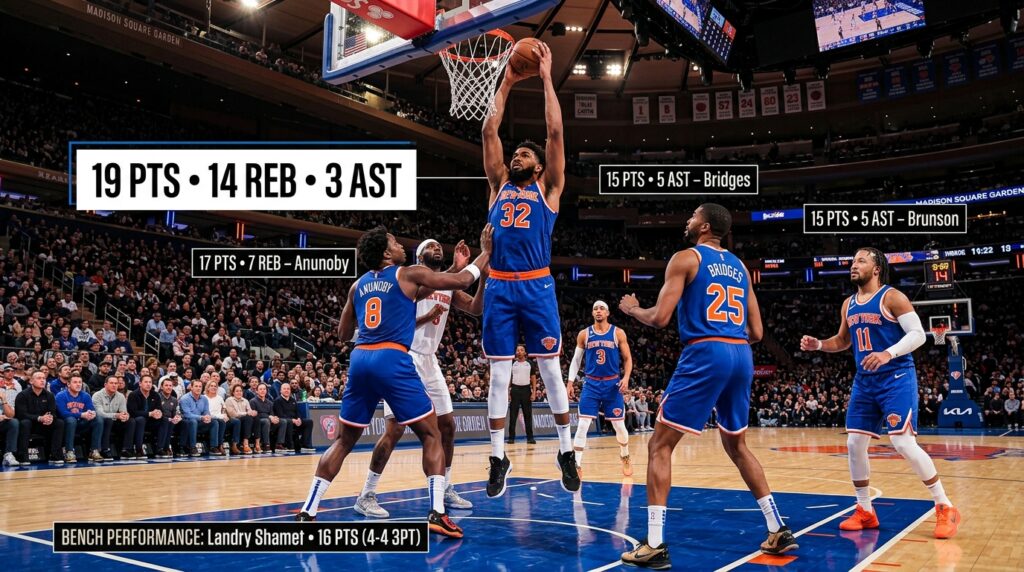
Karl-Anthony Towns delivered one of New York’s strongest all-around performances. He finished with 19 points, 14 rebounds, and three assists while shooting 8-for-11 from the field. He was also perfect from three-point range, making all three of his attempts. OG Anunoby added 17 points, seven rebounds, four assists, and two steals. Mikal Bridges scored 15 points with five assists and three rebounds, while Jalen Brunson also finished with 15 points and five assists. Josh Hart scored six points but made a major impact with 11 rebounds, six assists, and two steals.
The Knicks also received valuable scoring from their bench. Landry Shamet scored 16 points and made all four of his three-point attempts. Miles McBride added 11 points, two assists, and three steals, while Mitchell Robinson finished with eight points and 10 rebounds. Tyler Kolek scored eight points, and Pacome Dadiet added six. Jose Alvarado scored four points, Jordan Clarkson had three, and Ariel Hukporti finished with two. Mohamed Diawara did not score but still collected three rebounds and two assists. Jeremy Sochan did not play because of a coach’s decision.
Cleveland Cavaliers Player Stats
Donovan Mitchell carried much of Cleveland’s scoring responsibility and finished with 31 points. He also recorded four rebounds, one assist, and one steal. Mitchell shot 9-for-18 from the field and made five of his nine three-point attempts. He also went 8-for-10 at the free-throw line. Evan Mobley added 15 points, seven rebounds, and four assists, while James Harden scored 12 points with four rebounds and two assists. Jarrett Allen finished with six points, three rebounds, two steals, and two blocks. Max Strus added five points and two assists.
Cleveland received less scoring help from its bench. Thomas Bryant was the main reserve contributor with 10 points in fewer than nine minutes. Sam Merrill and Keon Ellis each scored five points, while Jaylon Tyson added two points, three rebounds, and two assists. Nae’Qwan Tomlin also scored two points. Dean Wade, Craig Porter Jr., and Tyrese Proctor did not score, although Porter added three assists and Wade recorded two steals. Larry Nance Jr. did not play because of a coach’s decision.
How to Read the Box Score Numbers
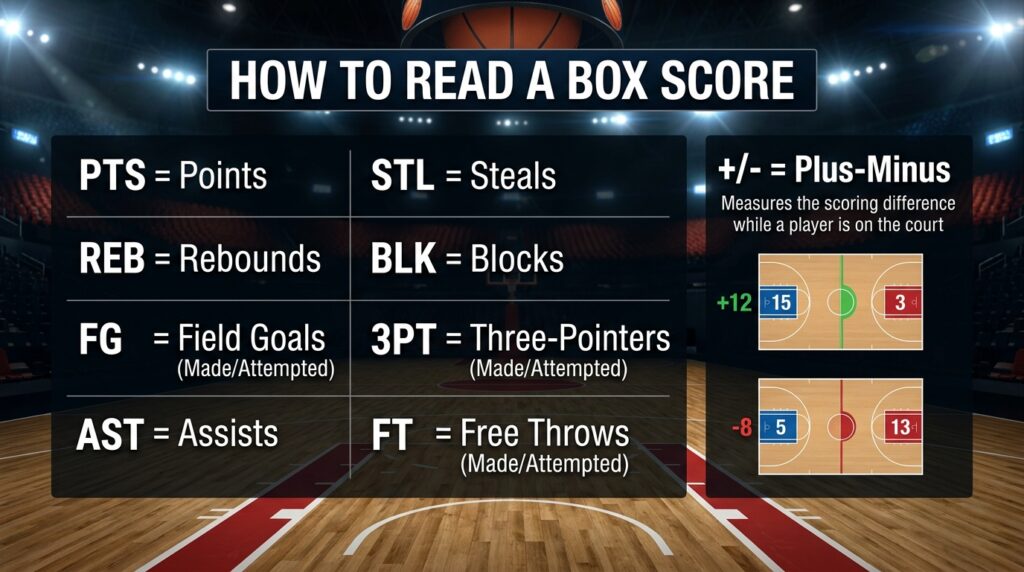
A basketball box score can seem confusing at first, especially if you only focus on points. PTS means points, REB means rebounds, and AST means assists. STL shows steals, while BLK means blocked shots. FG tells you how many field goals a player made and attempted. The 3PT column shows three-point shooting, while FT covers free throws. Together, these numbers help explain how a player performed in several areas of the game.
The plus-minus number gives another way to look at a player’s time on the court. A positive number means the team scored more points than its opponent while that player was playing. A negative number means the opponent scored more during those minutes. Plus-minus should not be used by itself to judge a player because lineups, matchups, and game situations can affect it. It is more useful when viewed beside shooting, rebounds, assists, steals, turnovers, and other stats.
Team Stats That Decided the Game
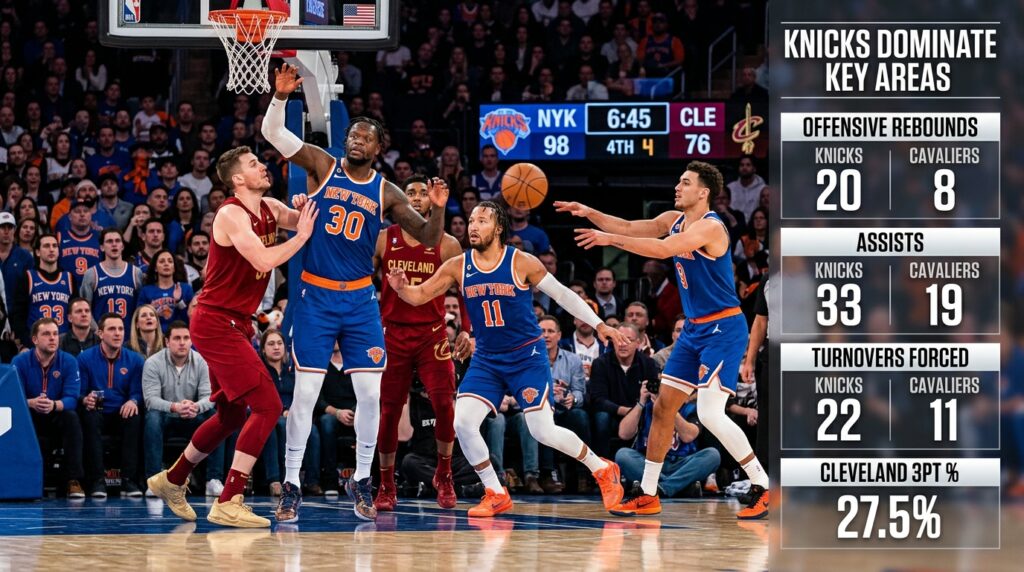
New York shot 49.0% from the field by making 48 of 98 attempts. Cleveland finished 32-for-77, which gave the Cavaliers a 41.6% field-goal percentage. The difference was even larger from three-point range. The Knicks made 19 of 43 three-pointers for 44.2%, while Cleveland made only 11 of 40 for 27.5%. The Cavaliers were better at the free-throw line, making 18 of 22 attempts compared with New York’s 15 of 20.
New York also had a major advantage when creating extra scoring chances. The Knicks grabbed 20 offensive rebounds, while Cleveland collected only six. New York finished with 33 assists and 15 steals compared with Cleveland’s 21 assists and nine steals. The Knicks scored 32 second-chance points, while the Cavaliers managed only five. New York also won the fast-break scoring battle 33–9 and outscored Cleveland 50–36 in the paint. These extra opportunities helped the Knicks build a large lead and keep control of the game.
Key Performances and Turning Points
Towns gave New York an efficient scoring option both inside and outside the paint. He scored 19 points on only 11 field-goal attempts, while his 14 rebounds helped the Knicks control missed shots. Shamet also caused problems for Cleveland with his shooting from the bench. Hart had another kind of impact, as his rebounding and passing helped New York keep possessions moving even though he did not take many shots.
Mitchell gave Cleveland its best individual scoring performance and finished with 31 points while shooting 50% from the field. The main problem was that Cleveland did not receive enough scoring support around him. Harden made only two field goals and missed all six of his three-point attempts. Mobley added 15 points, but the Cavaliers still could not match New York’s balanced attack. Six Knicks players reached double figures even though no New York player scored 20 points.
Why New York Won by Such a Large Margin
The Knicks created extra scoring chances in several important ways. Their 20 offensive rebounds allowed them to keep possessions alive after missed shots. Cleveland also committed 22 turnovers, giving New York more chances to attack before the Cavaliers could properly set their defense. The Knicks used those opportunities well and turned them into a clear advantage in transition and second-chance scoring.
New York also shared the ball well throughout the game. The Knicks recorded 33 assists on 48 made field goals, showing how often their scoring came through team play. Cleveland could not focus only on Brunson or Towns because several New York players were contributing. Cleveland’s 27.5% shooting from three-point range also made a comeback difficult. Once New York’s lead grew beyond 20 points, the Cavaliers needed quick baskets and defensive stops, but they could not produce enough of either.
What the Game Meant in the 2026 Playoffs
The Game 4 victory completed New York’s 4–0 sweep of Cleveland in the Eastern Conference Finals. The Knicks had already won Game 1 by 115–104 in overtime before taking Game 2 by a score of 109–93. They then won Game 3 by 121–108. The 130–93 victory in Game 4 was the biggest winning margin of the series and confirmed New York’s place in the NBA Finals.
Jalen Brunson received the Larry Bird Trophy as the Eastern Conference Finals MVP. He averaged 25.5 points while shooting 49% during the four-game series. His scoring total was lower in Game 4, but New York did not need him to carry the offense alone. Towns, Anunoby, Shamet, Bridges, and other teammates shared the scoring load, which became one of the clearest stories shown by the final Game 4 box score.
Frequently Asked Questions
What was the halftime score in Knicks vs Cavaliers Game 4?
New York led Cleveland 68–49 at halftime. The Knicks had already built a 19-point advantage after two quarters, leaving the Cavaliers with a difficult comeback task in the second half.
How many bench points did the Knicks score?
New York’s bench scored 58 points, while Cleveland’s reserves finished with 24. The 34-point difference showed how much extra scoring the Knicks received when their starters were resting.
How many points did New York score from Cleveland turnovers?
Cleveland committed 22 turnovers, and New York turned those mistakes into 34 points. Cleveland scored 18 points from Knicks turnovers, giving New York another clear advantage in the game.
Which player had the best plus-minus in Game 4?
Landry Shamet finished with a game-high plus-28. This means New York outscored Cleveland by 28 points during the minutes he was on the court. Shamet also scored 16 points in fewer than 19 minutes.
What was the attendance for Knicks vs Cavaliers Game 4?
The official scorer’s report listed an attendance of 19,432 at Rocket Arena. The game was also listed as a sellout.
How long did Knicks vs Cavaliers Game 4 last?
The official NBA scorer’s report listed the game time as two hours and 18 minutes. The matchup was played on Monday, May 25, 2026, in Cleveland.
Final Thoughts
The knicks vs cleveland cavaliers match player stats show that New York’s success came from a complete team performance. Cleveland had the game’s highest scorer in Donovan Mitchell, but the Knicks received strong contributions throughout their lineup. Towns controlled the rebounding battle, several players moved the ball well, and the bench gave New York another major scoring boost.
The 130–93 final score cannot be explained by points alone. Shooting, offensive rebounds, assists, turnovers, fast-break scoring, and second-chance opportunities all played a major role. Looking at the full box score makes it much easier to understand why New York controlled Game 4 and completed the Eastern Conference Finals sweep.
Disclaimer
This article is for general information and was written with AI assistance. Sports records, player details, and team information may change over time. The article may not cover every later update or situation. Check official NBA information or other trusted sources when you need the latest details.