
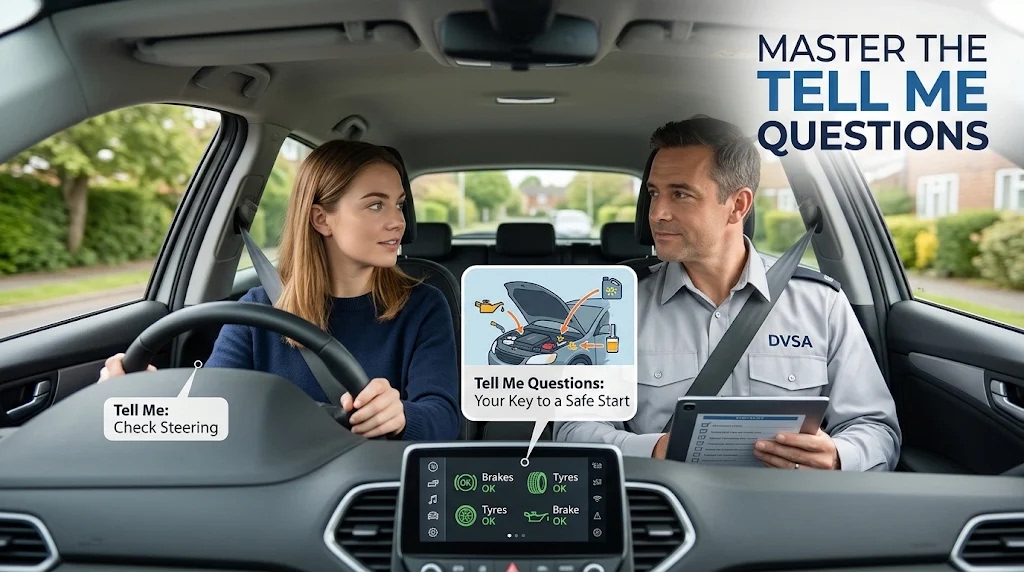
Many learners worry about the tell me questions driving test part. It comes early, before you move the car. You explain how you would check something, such as the brakes or the tyres. A wrong answer will not end your test on its own. Still, a calm answer helps you start with confidence.
You will learn what the questions are and when the examiner asks them. You will also see how the show me questions fit in. We cover what happens after a wrong answer. Then you get a simple way to learn the questions, plus common mistakes and easy fixes. Always check the official GOV.UK list before your test, because lists can change.
What Are Tell Me Questions on the UK Driving Test?
Tell me questions are short vehicle safety questions. The examiner asks one at the start of your car test, before you begin driving. You answer in words. For example, you might explain how you would check that the brakes work before a journey. These questions test whether you know how to keep a car safe and ready for the road. They are one part of the test, along with the eyesight check, general driving, manoeuvres, and independent driving.
People also call them show me tell me questions. That name covers two types. A tell me question is spoken, while a show me question is something you do. Both types check that you know your car and can use its main controls safely. The official GOV.UK car list is for England, Scotland and Wales.

How the Show Me and Tell Me Part Works on Test Day
You get two questions in total. The examiner picks one tell me question and one show me question from the official list. The tell me question comes first, before you drive off. You explain your answer out loud. If the question is about the engine bay, you need to open the bonnet and tell the examiner how you would do the check. Official guidance names questions 12, 13, and 14 as the ones that need this.
The show me question comes later, while you are driving. For example, the examiner may ask you to show how you would wash the rear windscreen. You do it only when it is safe. Your driving still comes first. Do not worry if you need a moment to find the right control. The examiner wants to see that you can use it safely.
The 14 Tell Me Questions and What They Cover
The official list has 14 tell me questions. They cover safety checks that a driver should know. Some are about tyres, such as the tread depth and the general condition. Others cover the brakes, the steering, the lights, and warning lights on the dashboard. A few ask about fluids under the bonnet, such as engine oil, coolant, and brake fluid.
Here are two simple examples. For the brakes, you can say the pedal should not feel spongy or slack. When you move off, the car should not pull to one side. For the tyres, you can say they should have no cuts or bulges. The legal minimum tread depth for a car is 1.6 mm across the central three-quarters of the tyre. Use your own words, but keep the facts right.
Show Me Questions: What You Do While Driving
The list has seven show me questions. Each one asks you to use a control in the car. You might wash the rear windscreen or switch on your dipped headlights. The headlight task comes with a clear safety rule: do it only when it is safe. These jobs sound easy, but nerves can make you forget where a switch is.
Controls sit in different places in different cars. A wiper lever, a light dial, or a demister button may not be where you expect. Practise in the exact car you plan to use on test day. If you use your instructor’s car, ask them to show you each control. In a parked car, say each action out loud as you do it. This links the words to the movement.
What Happens If You Get a Question Wrong?
A wrong answer does not fail your test by itself. If you get one or both questions wrong, you get one driving fault. A driving fault is sometimes called a minor. You can pass with up to 15 minors, as long as you have no serious or dangerous faults. So one fault from the questions is a small cost. Still, it uses up part of your fault allowance, so it is worth learning the answers.
There is one case where a show me question can lead to a fail. You fail if your driving is dangerous or potentially dangerous while you answer. For example, looking down for too long to find a switch could cause a problem. If you cannot find a control quickly, keep your eyes on the road. Tell the examiner you will do it when it is safe. A calm, safe choice is better than a rushed one.
A Simple Way to Learn the Questions
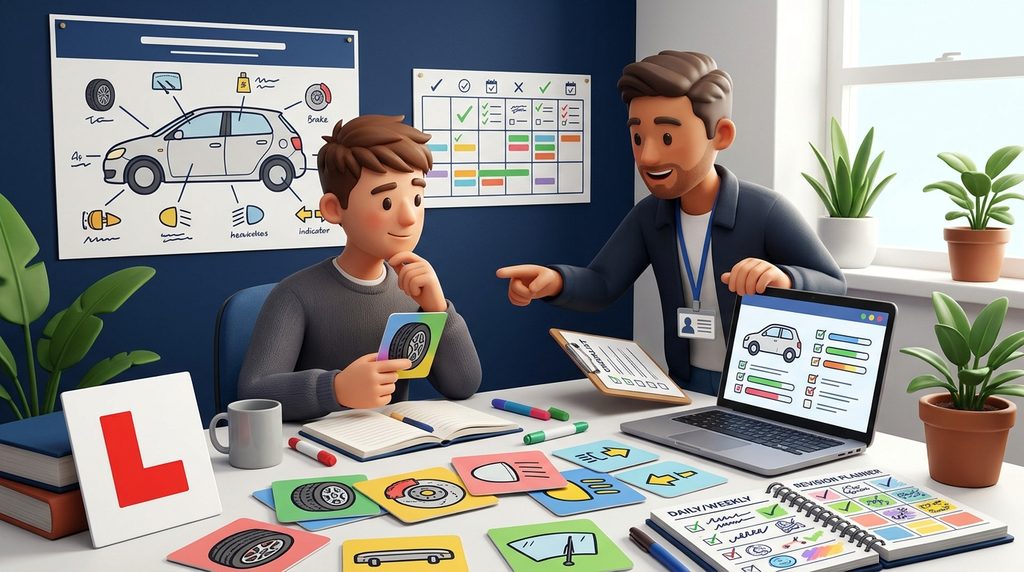
Start with the official list on GOV.UK. Read each question and the model answer once. Then learn them in small groups. Try three or four a day over a week. Make flash cards, or save your own notes as a PDF on your phone. Check that your notes match the official list.
Next, ask a friend or your instructor to ask you tell me questions. Answer out loud, like on test day. Repeat the hard ones more often. A good test of learning is to explain the answer to someone else. Do a quick run-through the week before your test. You only need two answers on the day, but you will not know which two. So learn the full list.
Common Mistakes and Easy Fixes
One common mistake is learning answers word for word and then freezing. Instead, learn the idea behind each answer. For example, imagine a learner named Mia. She memorised a script but lost her place when nerves hit. Next time, she learned the idea of each check and used her own words. She felt calmer, and the examiner could follow her answer. A short, clear answer that covers the key facts is a good aim.
Another mistake is skipping the bonnet questions. Some learners never practise opening the bonnet, so they feel lost on the day. Ask your instructor to show you the release and the fluid caps. A third mistake is relying on old lists or unofficial pages. Lists can change, so check GOV.UK close to your test date. A quick check costs nothing.
How to Stay Calm and Answer With Confidence
Nerves can make simple things feel hard. Take a slow breath before you answer. Listen to the full question. Picture a short checklist in your head and walk through it one step at a time. A steady, clear answer is the goal, not a perfect speech.
Different learners may need different help. If English is not your first language, learn the key words for each part of the car. If you have a physical condition that affects some controls, talk to your instructor early. They can help you plan how to show the task safely. You can also contact the DVSA before your test to explain any needs. Early planning removes stress on the day.
Frequently Asked Questions
Is there a quiz for the tell me questions?
Yes, many websites and apps offer free quizzes. They can help you spot gaps in what you know. Use them for practice only, because they are not the official source. Some quizzes may use wording that differs from GOV.UK. Check any answer you are unsure about against the official list. Also be careful before you give your email or other details to a quiz site.
Can I download the questions as a PDF?
The official questions are published on a GOV.UK page, so you can read them there for free. You can save or print that page for your own notes. Some driving schools and websites also offer PDFs. Check that any PDF matches the current GOV.UK list. Use trusted sites, and be careful before you share personal details to get a download.
Do the questions change in 2026?
Lists can change, so do not rely on memory or old notes. At the time of writing, the official car list page shows its last update as 2017. This guide cannot confirm any 2026 change from that page. Check GOV.UK a few days before your test. Your instructor should also know about any changes.
Do the same questions apply in Northern Ireland or on other vehicle tests?
Not always. The GOV.UK car list applies to England, Scotland and Wales. Northern Ireland has its own driving test service, so use its official nidirect pages. Motorbike, lorry, and bus tests have their own safety question lists. Always check the list for the exact test you booked.
What should I do if my mind goes blank?
Pause and take a breath. Ask the examiner to repeat the question if you need to. Then say what you do know, in simple words. A partial answer may still show the right idea. If you still cannot answer, let it go and focus on your driving. The rest of the test matters much more.
When should I start learning the questions?
Start a few weeks before your test, once you have a date. Short daily sessions work better than one long night before. Add a quick review in the final week. If you learn early, you can spend your last lessons on driving skills instead. The questions are only a small part of the test, but they are easy marks to protect.
Final Thoughts
The tell me questions driving test part is small, but it is worth your time. You get one tell me question and one show me question. A wrong answer gives one minor, and only dangerous driving while you answer can cause a fail. Learn the ideas, not only the words, and practise in the car you will use.
Your next step is simple. Open the official GOV.UK list and read each question once. Then learn a few each day, and test yourself with a friend or your instructor. Check the list again close to your test date, because details can change. Go in calm, and let the questions become the easy start to your test.
Disclaimer
This article is for general information only. It was written with AI assistance. Rules, test formats, and question lists may change, and this guide may not cover every situation. Please check important or current details through official or trusted sources, such as GOV.UK and the DVSA, before you rely on them.