
Many people ask how many weeks in 6 months because they need to plan something. It might be a work project, a savings goal, a fitness plan, or a baby’s age. The short answer is about 26 weeks. That number works well for everyday planning. The exact count can change by a few days, though. Months have different lengths, and that small gap confuses many readers. This guide clears it up in plain words. You will not need any math skills.
First, you will see the quick answer and the easy math behind it. Next, you will learn why the answer changes with the calendar, including leap years such as 2020 and 2024. Then the guide covers 6 months of pregnancy and a 6-month-old baby, since these questions come up often. You will also find real-life uses, common mistakes, and six short answers to related questions. Each part gives you steps you can use right away.
The Quick Answer: How Many Weeks Are in 6 Months?
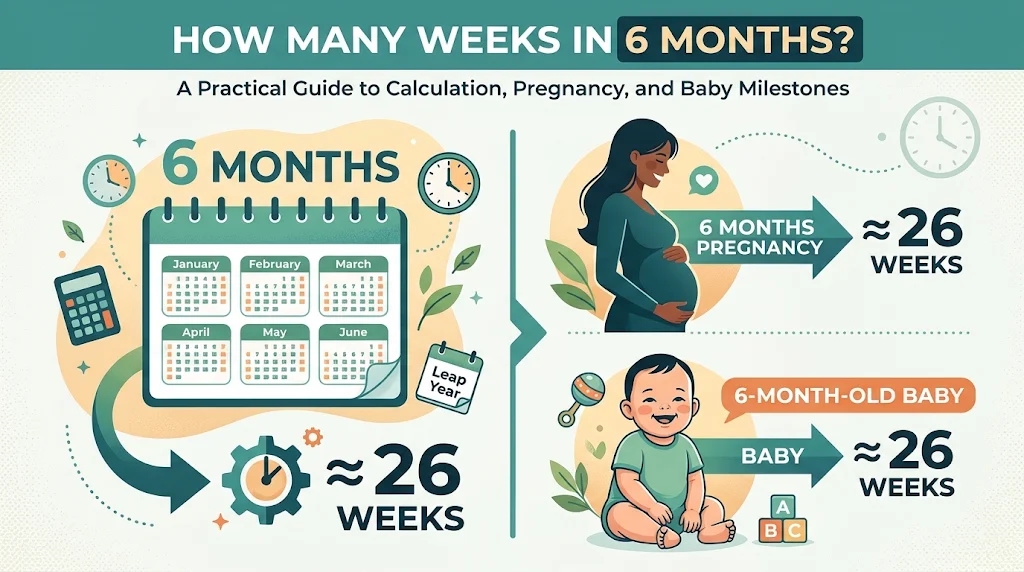
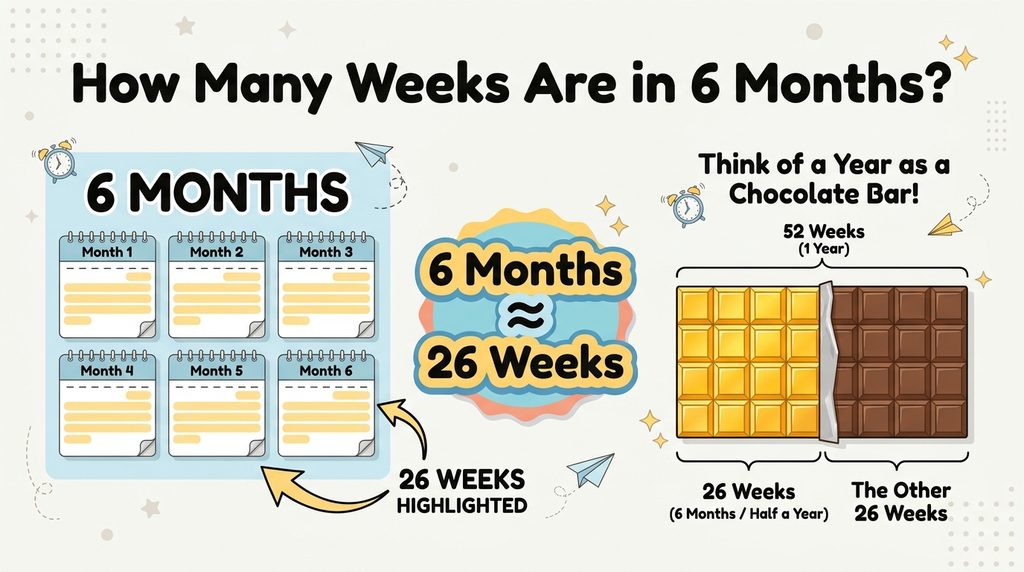
Six months is about 26 weeks. A year has 52 weeks plus one extra day. Half of that gives you 26 weeks. Think of a year as a long chocolate bar with 52 small squares. Six months is half the bar, so you get 26 squares. This simple picture helps when you need a fast answer. You can use 26 weeks for rough plans, such as a goal or a short course. The next sections show how to be more exact.
The exact answer depends on which six months you count. From 1 January to 30 June 2026, you get 181 days. That equals about 25.9 weeks. From 1 July to 31 December 2026, you get 184 days, which is about 26.3 weeks. So 26 weeks is a very good rule. It is not exact for every date range. This is the main reason different websites show slightly different answers. If you need a precise number, count the days and divide by 7.
How to Work Out the Weeks Yourself
The easiest way uses days. First, count the days between your start date and your end date. Next, divide that number by 7. The answer is your number of weeks. For example, 13 November 2026 to 13 May 2027 is 181 days. Divide 181 by 7, and you get about 25.9 weeks. Use the same steps to find how many weeks in 6 months from today. Just use today’s date as your start. A calendar app can count the days for you.
You can also use a quick shortcut. A month has about 4.35 weeks on average. Multiply 6 by 4.35, and you get about 26.1 weeks. This shortcut works well when you do not have exact dates. It is also easy to do on a phone. Keep in mind that it gives an estimate. Pick the shortcut for rough plans and the day count for exact ones.
Why the Number Changes by a Few Days
Months do not all have the same length. Some have 30 days, some have 31, and February has 28 or 29. Because of this, six months in a row can have between 181 and 184 days. A week always has 7 days, so the weeks total shifts a little. That range gives about 25.9 to 26.3 weeks. Imagine two trips that both last six months. One may be a few days longer, just because of the months it covers.
The year matters only a little. Leap years add February 29. The years 2020 and 2024 were leap years. The years 2021, 2022, 2023, and 2025 were not, and 2026 is not one either. In a leap year, January to June has 182 days. That is exactly 26 weeks. In 2026, the same stretch has 181 days. So the year changes the answer by one day at most. That is a very small change for most plans. The next leap year is 2028.
A Step-by-Step Example
Let us try a full example. Imagine you start a study plan on 1 March 2026. You want it to last six months, so it ends on 31 August 2026. March has 31 days, April has 30, May has 31, June has 30, July has 31, and August has 31. Add those numbers, and you get 184 days. Divide 184 by 7. The answer is about 26.3 weeks, or 26 weeks and 2 days. This way works for any start date.
Now try a start date in late autumn. Say you begin on 1 September 2026 and end on 28 February 2027. September has 30 days, October 31, November 30, December 31, January 31, and February 28. That adds up to 181 days. Divide by 7, and you get about 25.9 weeks, or 25 weeks and 6 days. The two plans both last six months, but one is a few days shorter. This is a good reminder to count from your real dates.
How Many Weeks Are in 6 Months of Pregnancy?
Pregnancy is counted in weeks, not months. A full pregnancy lasts about 40 weeks. Doctors usually count from the first day of the last period, not from the day of conception. This is why simple math with 4 weeks per month does not fit well. Nine months by that math gives 36 weeks, which is too low. Many people use a pregnancy calculator to turn weeks into months. The result is an estimate. Your own dates may differ from a chart.
When someone says they are six months pregnant, they often mean about 26 weeks. Some charts place the sixth month between weeks 23 and 27. Other charts use slightly different ranges. The third trimester usually begins around week 28. Your due date and week count come from your healthcare provider. They may adjust the date after an ultrasound. Use the chart as a guide, not as a medical answer. If you want to know your exact stage, ask them.

How Many Weeks Are in 6 Months for a Baby?
A baby who is 6 months old is about 26 weeks old. Parents often switch from weeks to months after the first few months. Weeks can still help when you track feeding, sleep, or growth. Some baby apps and charts show both numbers. Small differences are normal because months vary in length. A baby who is 26 weeks old may be a few days away from the 6-month mark. Many parents find weeks easier for early baby notes.
Babies born early can be a special case. Doctors may use a corrected age, which counts from the due date instead of the birth date. A baby born several weeks early may have a lower corrected age than birthday age. Your child’s doctor can tell you which age to use for check-ups and milestones. Do not rely on a calculator alone for health choices. Ask early if you feel unsure about your baby’s age count.
Real-Life Ways to Use 26 Weeks
Weeks help when you want steady steps. Imagine you want to save money for six months. If you save the same amount each week, you can divide your goal by 26. A goal of 2,600 would mean 100 each week. This feels clearer than uneven months. The same idea works for a fitness plan, a study plan, or a work project. Weekly checkpoints also make progress easier to see.
Weeks also matter at work. Some pay schedules pay people every two weeks. In 26 weeks, that gives about 13 pay periods. A business week has five working days. So 26 business weeks equal about 130 working days, before holidays. If a contract, lease, or course says 6 months, check the exact start and end dates. Written dates should guide you more than a rough 26-week rule. Ask the provider if the dates look unclear.
Common Mistakes and Easy Fixes
The biggest mistake is using 4 weeks for every month. Six times 4 gives 24, which is about two weeks too low. A month is usually a little longer than 4 weeks. Use 4.35 for a better estimate, or count the days. Another mistake is treating each month as 30 days. That gives 180 days, or about 25.7 weeks. It is close, but it is not exact. Both mistakes are easy to avoid.
Start dates cause a second problem. If you count the start day twice, you may be off by one day. Pick one rule and keep it. Also check whether a tool counts calendar weeks or working weeks. For pregnancy, do not mix a month chart from one source with a week chart from another. They may use different ranges. When two answers do not match, compare the dates first, then the rules each tool uses.
Frequently Asked Questions
How many days are in 26 weeks?
Twenty-six weeks equal exactly 182 days. That is close to half of a 365-day year, which is 182.5 days. It is also one day more than January to June in 2026. You can multiply any number of weeks by 7 to get days.
Is 24 weeks the same as 6 months?
No. Twenty-four weeks is about 5.5 months. It only looks like 6 months if you count every month as exactly 4 weeks, which is not accurate. For a better match, use 26 weeks. Week 24 can still fall inside the sixth month of pregnancy on some charts.
How does a pregnancy calculator turn weeks into months?
Many calculators ask for the first day of your last period or your due date. They count forward in days and then divide by 7. Some then place the week inside a month chart. Different tools use different charts, so the month can vary. Your healthcare provider confirms the final dates.
How many weeks are in 3, 9, and 12 months?
Three months is about 13 weeks. Nine months is about 39 weeks. Twelve months is 52 weeks plus a day or two. These numbers use the same average of 4.35 weeks per month, so treat them as estimates.
Does the day the week starts change the answer?
Many calendars start the week on Monday, and others start it on Sunday. A week still has 7 days either way. For this math, you only count 7-day blocks from your start date. The start day of the calendar does not change the total number of days. Only your start and end dates matter.
What is the easiest tool for counting weeks?
A phone calendar or a free date calculator works well. In many spreadsheet apps, you can subtract the start date from the end date to get days. Then divide by 7. Check one answer by hand, so you know the tool counts the way you expect.
Final Thoughts
The quick answer to how many weeks in 6 months is about 26. For exact dates, count the days and divide by 7. The result can be 25.9 weeks, 26 weeks, or 26.3 weeks, based on the months you pick. That small range is normal and does not mean your math is wrong. With one simple rule, you can check any date range in a minute. The same skill helps you plan goals, budgets, and schedules.
For pregnancy, remember that weeks come first and months are only a rough guide. For a baby, 26 weeks is a helpful number, but a doctor’s advice comes first when age affects care. Next, write down your start date and end date. Then run the quick check from this guide and keep the result with your plan. If the dates matter for money, law, or health, confirm them with the official source.
Disclaimer
This article is for general information only. It was written with AI assistance. Information may change, and it may not cover every situation. Please check important or current details with official or trusted sources before you rely on them. For health questions, speak with a qualified healthcare provider.