

The latest Bengals vs Pittsburgh Steelers match player stats come from their Week 3 game on September 27, 2026. Pittsburgh won 30-27 at Acrisure Stadium after a close battle that stayed undecided until the final minute. Both teams entered the game with 2-0 records, so the result gave Pittsburgh its third win and Cincinnati its first loss. The Bengals had a strong passing game behind Joe Burrow, while Pittsburgh answered with Aaron Rodgers, Jaylen Warren, and several important big plays.
The numbers show that this game was about much more than the two quarterbacks. Burrow threw three touchdown passes without an interception, while Rodgers also threw three touchdowns and finished with more passing yards. Warren gave Pittsburgh a clear advantage in the running game. Ja’Marr Chase and Tee Higgins were Cincinnati’s main receiving threats. Turnovers, field goals, and one important defensive play in the final minute also had a major effect on the result.
Bengals vs Pittsburgh Steelers Match Player Stats: Game Overview
Pittsburgh finished the game with 411 total yards, while Cincinnati had 352. The Steelers also gained 138 rushing yards compared with 83 for the Bengals. Pittsburgh ran 59 offensive plays and averaged 7.0 yards per play. Cincinnati ran 56 plays and averaged 6.3 yards. Possession time was almost even, as Cincinnati held the ball for 30:06 and Pittsburgh had it for 29:54. This shows that possession time was not the main difference. Pittsburgh simply gained more yards with almost the same amount of time on offense.
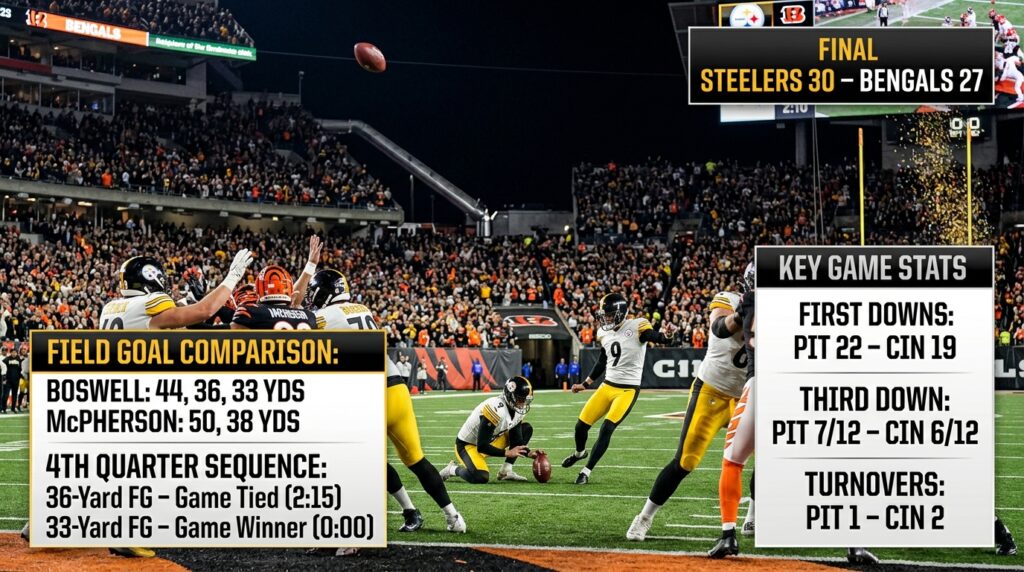
The scoring stayed close throughout the game. Pittsburgh led 14-7 after the first quarter, but Cincinnati fought back in the second. The teams went into halftime tied at 17-17. Cincinnati moved ahead 20-17 during the third quarter before Pittsburgh responded and took a 24-20 lead. The Bengals then went back in front 27-24 early in the fourth quarter. Chris Boswell tied the game with a 36-yard field goal and later made a 33-yard kick that gave Pittsburgh the final 30-27 lead.

Joe Burrow and the Bengals Passing Attack
Joe Burrow completed 28 of 37 passes for 282 yards. He threw three touchdowns and no interceptions, finishing with a passer rating of 123.9. Burrow connected with Ja’Marr Chase for a 3-yard touchdown during the first quarter. Near the end of the second quarter, he found Tee Higgins for a 28-yard touchdown. His third scoring pass came in the fourth quarter when he connected with Mike Gesicki for a 25-yard touchdown that gave Cincinnati a 27-24 lead.
Cincinnati spread the ball well through several receivers. Chase led the Bengals with nine catches for 98 yards and one touchdown. Higgins finished with six catches for 90 yards and a score, while Gesicki added three catches for 37 yards and one touchdown. Burrow recorded 282 passing yards, but Cincinnati finished with 269 net passing yards. The lower team total came because sack yardage is taken away from the team passing total. This is why quarterback passing yards and net team passing yards can sometimes be different.
Aaron Rodgers and the Steelers Offensive Leaders
Aaron Rodgers completed 19 of 34 passes for 292 yards. He threw three touchdowns and one interception, giving him a passer rating of 101.6. Rodgers started the scoring with a 38-yard touchdown pass to Roman Wilson. Later in the first quarter, he connected with Ben Skowronek for a 23-yard touchdown. His third touchdown came during the third quarter when he found DK Metcalf for a 6-yard score. Rodgers completed fewer passes than Burrow, but Pittsburgh produced more yards on many of its successful throws.
Rodgers also made important completions during Pittsburgh’s final scoring drive. He completed a 14-yard pass to Metcalf before connecting with Darnell Washington for a 47-yard gain. That long play moved the Steelers deep into Cincinnati territory and helped set up Boswell’s winning field goal. Washington finished with three catches for 67 yards. Roman Wilson recorded three catches for 60 yards and a touchdown, while Jaylen Warren added three receptions for 49 yards from the backfield.

Running and Receiving Stats That Shaped the Game
Jaylen Warren produced the strongest rushing performance of the game. He carried the ball 17 times for 127 yards, averaging about 7.5 yards per carry. He also caught three passes for 49 yards, giving him 176 total yards from scrimmage. Warren’s running helped Pittsburgh finish with 138 rushing yards as a team. He also had a long run taken away by a holding penalty, so it did not count in the official statistics. Even without that play, his 127 rushing yards gave Pittsburgh a major advantage on the ground.
Cincinnati did not have the same level of success in the running game. Chase Brown led the Bengals with 61 yards on 13 carries. Burrow added 13 yards on two rushing attempts, while Samaje Perine gained nine yards on three carries. The Bengals did not score a rushing touchdown, so much of their offensive success came through the passing game. Chase and Higgins combined for 188 receiving yards on 15 catches. Cincinnati moved the ball well through the air, but Pittsburgh had a more balanced attack because of Warren’s rushing production.
Defense, Turnovers, and Special Teams
The biggest defensive play came during Cincinnati’s final possession. The Bengals had moved into Pittsburgh territory and were trying to answer the Steelers’ go-ahead field goal. Derrick Harmon then sacked Burrow and forced a fumble. Sebastian Joseph-Day recovered the ball for Pittsburgh, allowing the Steelers to finish the game with kneel-downs. It was Pittsburgh’s only sack of the game, but it came at the most important moment. Patrick Queen also played a strong defensive game and recorded a game-high 13 tackles, one tackle for loss, and one pass defended.
Cincinnati also made important defensive plays. Jordan Battle intercepted a tipped Rodgers pass late in the second quarter. The Bengals quickly turned that takeaway into Higgins’ touchdown, which tied the game at 17 before halftime. Special teams became important again during the fourth quarter. Cincinnati returner Ke’Shawn Williams muffed a punt, and Ben Skowronek recovered it for Pittsburgh. The Steelers did not score a touchdown from the turnover, but Boswell made a 36-yard field goal to tie the game at 27.
Kicking, Third Downs, and the Small Margins
Both kickers performed well throughout the game. Cincinnati’s Evan McPherson made field goals from 50 and 38 yards. He also converted the extra points after all three Bengals touchdowns. Pittsburgh’s Chris Boswell made field goals from 44, 36, and 33 yards. His final two field goals came during the fourth quarter. The 36-yard kick tied the score, while his 33-yard field goal put Pittsburgh ahead for good. In a game decided by only three points, those successful kicks became very important.
Pittsburgh also held a small advantage on third down. The Steelers converted 7 of 12 third-down attempts, while Cincinnati finished 6 of 12. The Bengals converted both of their fourth-down attempts, including one during the drive that ended with Gesicki’s touchdown. Pittsburgh did not attempt a fourth-down conversion. The Steelers finished with 22 first downs compared with Cincinnati’s 19. These differences were small, but they helped Pittsburgh keep several drives alive. The Steelers also committed one turnover, while Cincinnati lost the ball twice.
What the Stats Say About Why Pittsburgh Won
The final score was close because both quarterbacks played well. Burrow completed a higher percentage of his passes and did not throw an interception. Rodgers finished with more passing yards and helped Pittsburgh create several long gains. Warren also gave the Steelers a major boost with 127 rushing yards. Pittsburgh ended the game with 59 more total yards and 55 more rushing yards than Cincinnati. That extra ground production gave the Steelers another way to move the ball when the passing game slowed down.
Turnovers became especially important late in the game. Cincinnati’s muffed punt gave Pittsburgh good field position in the fourth quarter, and the Steelers used the chance to tie the score. Burrow’s lost fumble then ended Cincinnati’s final drive after Pittsburgh had taken the lead. Cincinnati did turn Pittsburgh’s only turnover into a touchdown before halftime, but the Bengals could not overcome their two lost fumbles. The game shows why yards and touchdowns do not tell the whole story. One turnover or one defensive play at the right moment can completely change the result.
Frequently Asked Questions
Who won the Bengals vs Pittsburgh Steelers game on September 27, 2026?
The Pittsburgh Steelers won the game 30-27 at Acrisure Stadium. The victory moved Pittsburgh to 2-1, while Cincinnati also fell to 2-1 after suffering its first loss of the season.
How many passing yards did Joe Burrow have against the Steelers?
Joe Burrow finished with 282 passing yards. He completed 28 of 37 passes and threw three touchdowns without an interception. His passer rating for the game was 123.9.
How many passing yards did Aaron Rodgers have against the Bengals?
Aaron Rodgers threw for 292 yards against Cincinnati. He completed 19 of 34 passes and finished with three touchdowns and one interception. His passer rating was 101.6.
Who had the most rushing yards in the game?
Jaylen Warren led all players with 127 rushing yards on 17 carries. He also caught three passes for 49 yards, giving him 176 total yards from scrimmage.
Who led Cincinnati in receiving yards?
Ja’Marr Chase led Cincinnati with 98 receiving yards on nine catches. Tee Higgins followed closely with 90 yards on six receptions. Both players also caught a touchdown pass.
What play decided the game late?
Derrick Harmon sacked Joe Burrow during Cincinnati’s final drive and forced a fumble. Sebastian Joseph-Day recovered the ball for Pittsburgh, allowing the Steelers to protect their 30-27 lead and finish the game.
Final Thoughts
The Bengals vs Pittsburgh Steelers match player stats show just how close this game was. Burrow threw three touchdowns and kept Cincinnati dangerous throughout the afternoon. Chase and Higgins both produced strong receiving numbers, while Rodgers answered with three touchdown passes for Pittsburgh. Warren added the best rushing performance of the game and helped the Steelers build a more balanced offense. Pittsburgh finished with 411 total yards and created several important big plays.
The difference came down to execution during the final minutes. Boswell made two fourth-quarter field goals, including the winning kick. Pittsburgh also recovered two Cincinnati fumbles, with the final recovery ending the Bengals’ last chance to respond. The passing numbers were a major part of the game, but they did not decide everything. Pittsburgh’s running game, special teams, defense, and late turnovers played an equally important role in the 30-27 victory.
Disclaimer
This article is for general information and was written with AI assistance. NFL statistics and team information may change after official reviews or later updates. The article may not cover every detail, so readers should check official NFL or team sources for important and current information.