
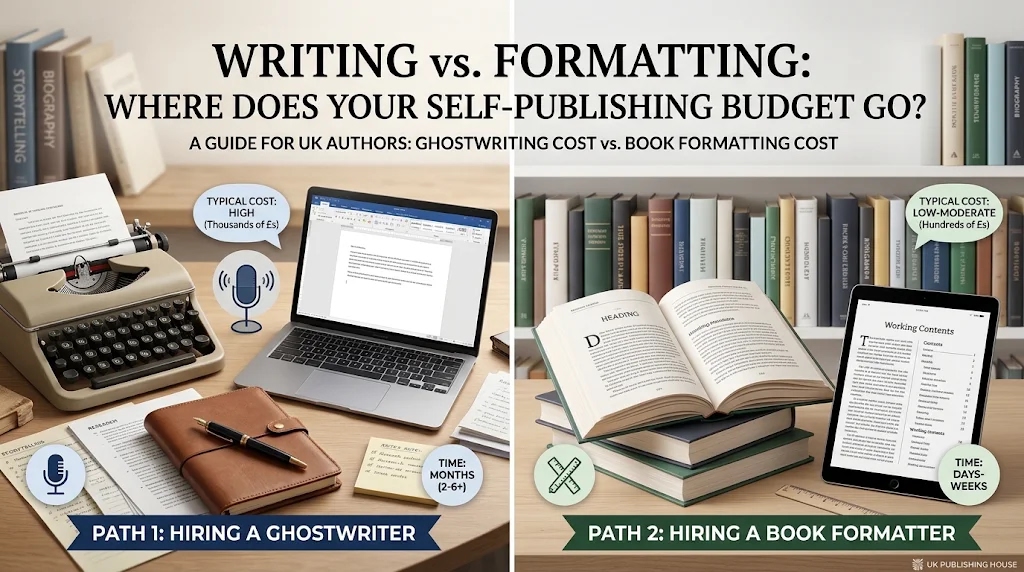
Book Formatting Service or Book Ghostwriter UK Costs: Every UK author who sits down to self-publish eventually runs into the same fork in the road. One path is about getting the words onto the page in the first place. The other is about making those words look like they belong on a shelf next to a traditionally published title. Both cost money. Both take time. And most authors have no real sense of which one will actually cost more until they have already paid for it.
That question, what costs more, hiring someone to write my book or hiring someone to format it, comes up constantly in author forums, Facebook groups, and emails to publishing consultants. The honest answer is that it depends entirely on what stage your manuscript is at and what you are trying to achieve. This piece breaks down both costs properly, so you can budget sensibly instead of guessing and ending up short halfway through the process.
Why So Many UK Authors Are Paying for Outside Help
Self-publishing in the UK has moved well past the hobby stage it occupied a decade ago. It now makes up a meaningful share of ebook sales across the country, and that growth shows no sign of slowing down. Audiobooks have followed a similar pattern, with double digit growth recorded in the UK over recent years as more readers shift towards listening rather than reading on a page. More titles are going out under independent authors’ own names than ever before, and a growing number of those authors are treating writing as a genuine business rather than a side project they fit in around a day job.
With that shift has come a change in reader expectations. Someone who picks up a self-published novel or a business book today expects the same level of polish they would get from a well-known publishing house. A manuscript with inconsistent margins, orphaned headings, or clumsy pacing gets noticed immediately, and not in a good way. Reviews reflect it, return rates reflect it, and word of mouth suffers because of it.
That shift in expectations has pushed two very different kinds of spending to the top of most authors’ budgets. The first is paying someone to help shape, develop, or write the manuscript itself. The second is paying someone to turn a finished draft into a properly formatted, retailer-ready book. These are not the same job; they do not require the same skills, and they absolutely do not cost the same amount. Understanding the difference early saves a lot of wasted money and frustration later in the process.
What a Professional Formatting Specialist Actually Does
Formatting is the technical and visual side of bookmaking. It takes a finished manuscript, usually a Word document or something similar, and turns it into files that are genuinely ready for print and for ebook retailers. It has nothing to do with the quality of the writing itself. A beautifully written manuscript can still look amateurish on the shelf if the formatting is done badly, and an average manuscript can look far more professional than it has any right to with the right layout work behind it.
Print Formatting
Print formatting deals with everything a reader sees on a physical page: trim size, margins, running headers, drop caps, chapter openings, page numbering, widow and orphan control, and the front and back matter that frames the actual content. Getting this wrong does not just look unpolished; it can also get a file rejected outright by a print-on-demand platform, which costs an author time they did not plan to lose.
Ebook Formatting
Ebook formatting is a different discipline entirely. It has to work across dozens of screen sizes and reading apps, which means using reflowable text, clean internal code, a working table of contents, and image handling that does not break on smaller devices. A file that looks perfect in print can fail completely as an ebook if it has not been converted properly, often in ways the author only discovers after a reader complains.
Below is a rough picture of how formatting cost tends to scale, depending on the complexity of the book involved.
| Book type | Relative cost | What drives the price |
| Straightforward novel or memoir (text only) | Lowest | Simple layout, minimal design decisions |
| Non-fiction with headings, tables or charts | Low to moderate | More structure, more formatting rules to apply consistently |
| Illustrated non-fiction or children’s picture book | Highest | Image placement, colour accuracy, custom layout per page |
| Combined print and ebook package | Moderate | Two separate file types, two sets of technical requirements |
This varies depending on turnaround time, how many rounds of revisions are included, and whether the service also builds the ebook’s clickable table of contents and metadata correctly. A specialist formatter can usually turn a finished manuscript around within a few days to a couple of weeks, which is considerably faster than most authors manage when attempting the job themselves for the first time without any prior experience.
What You Are Really Paying For When Someone Else Writes Your Book
Hiring someone to help write a book sits on a completely different part of the spending scale. This is not a technical task with a fixed set of rules to follow. It is a creative and often deeply personal collaboration, and the price reflects exactly that.
There is a wide range of arrangements that fall under this general umbrella. At one end, a writer might take detailed notes, recorded interviews, or a rough outline from the author and produce a full, polished manuscript from scratch. At the other end, someone working more like a book doctor or developmental editor might take an author’s own draft and rework the structure, pacing, and prose without writing it from scratch. Both are common across the UK market, and both get lumped together loosely under the same general heading, even though the actual amount of writing involved is very different between the two.
What Drives the Price
Genre and purpose matter enormously here. A business book meant to build authority for a founder or executive involves research, interviews, and a level of precision that commands a higher rate. A memoir involves long interview sessions and a writer’s ability to capture someone else’s voice convincingly on the page, which is a rare and genuinely valuable skill few people have. Genre fiction, by contrast, often has a more established price per word because the writer is not extracting a life story from scratch; they are building a plot and characters against an agreed brief.
| Book type | Relative cost | Why |
| Memoir or life story | Highest | Interviews, research, and capturing a real person’s voice accurately |
| Business or leadership book | High | Research, structure, and credibility, often tied to a launch date |
| Self-help or personal development | High | Needs a clear framework plus an authentic, relatable tone throughout |
| Genre fiction (thriller, romance, fantasy) | Moderate to high | Priced more by length and plot complexity than by research time |
Timeframes vary just as widely as the price. A short non-fiction title might take two to three months from an initial brief to a finished manuscript. A full-length memoir or business book with heavy research and multiple interview rounds can take six months or longer to get right. Anyone quoting a full book in under a month is either working from an unusually detailed brief already, or cutting corners that tend to show up later once a reader actually picks the book up.
Formatting or Writing Help: Which One Actually Costs More
Put plainly, hiring someone to help write your book will almost always cost considerably more than hiring someone to format it. That is not a knock against formatting specialists or their skill. It simply reflects the sheer difference in hours, judgement, and risk involved in each job.
A formatter is working with content that already exists. Their task is technical execution against a known set of rules, and it is largely repeatable, which keeps the price contained within a fairly narrow range. A writer, on the other hand, is creating something from nothing, carrying the weight of getting the voice, structure, and substance right across tens of thousands of words, usually over several months of sustained work. That is a fundamentally more expensive kind of labour, and the market prices it accordingly, whether an author likes it or not.
| Professional formatting | Writing or development help | |
| Relative cost | Low | High to very high |
| Typical turnaround | A few days to two weeks | Two to six months, sometimes longer |
| What you are buying | Technical layout and file preparation | Research, structure, prose, and voice |
| Skill required from you | Almost none, just a finished manuscript | A clear vision and availability for interviews or feedback |
| Who typically needs it | Every self-published author, without exception | Authors short on time, writing skill, or confidence in their own draft |
When a Book Genuinely Needs Both
Most authors who go the full self-publishing route end up needing both kinds of support at different points, just not at the same time. The writing or development work happens first, because there is little point in formatting a manuscript that is still being rewritten and restructured. Once the content is locked in and properly edited, formatting becomes the final technical step before the book actually goes live on any retailer.
If you are at the early stage and already know the writing itself is the bigger hurdle, it is worth getting in touch early, since experienced writers often have waiting lists stretching several months out. If your manuscript is already finished and the only thing standing between you and publication is a properly laid out file, a formatting specialist can usually turn that around quickly and affordably once the text itself is settled.
The Hidden Costs Nobody Mentions Upfront
Formatting and writing support get most of the attention because they are the two biggest line items, but they are rarely the only costs involved in getting a book out into the world and in front of readers.
Editing is the cost authors underestimate most consistently. A developmental edit, a line edit, and a final proofread are three separate passes, often carried out by three different people with different specialisms, and skipping any of them tends to show up in reviews later in ways that are hard to undo. Cover design is another cost that varies enormously depending on whether an author wants a simple template-based cover or a fully custom illustrated piece. ISBNs, while not expensive individually, add up quickly if separate print, ebook, and audiobook editions are all being planned. And almost every author ends up paying for at least one round of unplanned revisions somewhere along the way, whether that is a formatting tweak after seeing a printed proof copy or a last-minute rewrite of a chapter that simply was not working as written.
None of these individual costs are enormous on their own, but stacked together they can noticeably stretch a budget that only accounted for the two headline costs of writing and formatting.
How to Budget Sensibly for Either Option
The authors who come out of this process genuinely happy with what they spent tend to share a few consistent habits worth copying.
They get a clear quote in writing before any work begins, including exactly what is covered and how many rounds of revisions are included in that price. They ask to see previous examples of finished work, whether that is a formatted interior sample or a short sample chapter, before committing any money at all. They separate must-have spending from nice-to-have spending, so that a tight budget goes towards editing and formatting quality rather than an expensive cover that will not matter much if the content inside the book is not solid. And they build in a reasonable buffer on top of any quote they receive, because almost every project runs into at least one unplanned extra along the way.
It also helps enormously to think carefully about sequencing. Paying for formatting before a manuscript is genuinely finished is one of the most common ways authors waste money, since any late changes to the text often mean paying for the same formatting fixes twice over.
A Few Questions Worth Asking Before You Pay Anyone
Before signing off on either kind of spend, it is worth sitting down and answering a short list of honest questions, since the answers usually make the decision much clearer than it first appears.
Is the manuscript actually finished, or does it still need serious structural work before anyone should be formatting it? Do you have a realistic sense of how long the writing side will take, given your own availability for interviews, feedback rounds, and approvals along the way? Have you asked for a sample of previous work in the same genre, rather than relying on a general portfolio that may not reflect the kind of book you are writing? And critically, does the quote in front of you actually say what happens if you need an extra revision round, or is that left vague until it becomes a problem later on?
Authors who answer these questions honestly before committing tend to spend less overall, not more, because they avoid paying twice for the same piece of work. A rushed decision made under deadline pressure, whether that is a launch date, a personal milestone, or simple impatience, is almost always the more expensive one in the long run.
Making the Right Call for Your Book
There is no single universal answer to which service costs more in your specific case, because it depends entirely on where your manuscript stands right now and what you are actually trying to achieve with it. If the writing itself is solid and the only barrier left is turning it into a properly laid-out, retailer-ready file, formatting is a relatively small and fast cost to clear before launch. If the bigger challenge is getting the words down at all, or shaping a rough idea into something genuinely readable, that is a bigger investment, but it is also the one that determines whether the book gets written in the first place.
At UK Publishing House, we work with authors at both ends of that journey. For writers who need help turning an idea into a finished manuscript, our ghostwriting service pairs you with experienced UK-based writers who specialise in exactly this kind of close collaborative work. And once a manuscript is genuinely ready, our formatting service handles the print and ebook layout from start to finish, so the book an author eventually holds in their hands looks every bit as professional as the story told inside it.
Either way, the goal stays the same. Spend money where it actually moves your book closer to being finished, and know in advance what each step involves before you commit to it.
Frequently Asked Questions
How much do ghostwriters charge in the UK?
Rates vary enormously depending on experience and book type. Writing help for a full-length book sits firmly at the higher end of self-publishing costs, while a formatter’s fee is a far smaller, more predictable line item by comparison.
How much does it cost to hire someone to write a book for you?
It depends heavily on genre and complexity. A memoir or business book involving interviews and research tends to cost considerably more than genre fiction, since the research and voice-capturing work takes longer regardless of final length.
What does a professional formatting specialist actually include?
A proper formatting job covers the full interior layout: margins, chapter openings, page numbering, and front and back matter for print, plus a working table of contents and clean code for ebook files. It does not usually include editing or proofreading, so those need to be arranged separately.
How long does book formatting take?
Most straightforward novels or memoirs can be turned around within a few days to two weeks once the manuscript is finished. More complex books with images, tables, or custom layouts, such as cookbooks or illustrated non-fiction, can take longer because each page needs individual attention.
Do I need both a ghostwriter and a formatter, or just one?
It depends entirely on where your manuscript stands. If the book is already written and simply needs to look professional, formatting alone is enough. If you have not yet got your ideas down on paper in a readable way, that is a writing problem first, and formatting should only happen once the text is finished.
Is hiring someone to write your book the same as hiring an editor?
No. An editor works on a manuscript that already exists, improving structure, pacing, or line-level prose. Someone hired to write the book is creating the manuscript largely from scratch, based on interviews, notes, or an outline, which is a far bigger undertaking and priced accordingly.
Can I format my own book instead of paying someone?
Yes, and many authors do, particularly for simple, text-only novels using available software. The trade-off is time and a steeper learning curve, since getting print and ebook files truly right on a first attempt is harder than it looks, and mistakes can lead to a file being rejected by a retailer.
What should I check before paying for either service?
Ask for a written quote that spells out exactly what is included and how many revision rounds come with it, and ask to see a sample of previous work in a similar genre or style. Clarifying this upfront avoids the most common cause of overspending: paying twice for the same piece of work.